



How to Calculate Your Truck’s Cost Per Mile (And Why It Matters)
Gross revenue feels good — right up until you subtract what it actually costs to run your truck. A settlement statement that shows $9,000 for the week looks like a great month. But if your true cost per mile trucking is higher than you think, that same $9,000 might barely cover diesel, your truck payment, and the tires you’ll need next quarter. Plenty of owner operators run themselves into the ground chasing gross numbers while their actual margin quietly disappears.
Cost per mile (CPM) is the one number that tells you the truth. It’s the average amount you spend to move your truck one mile, whether that mile is loaded, empty, or sitting at a shipper waiting on a lumper. Once you know your real cost per mile, every rate confirmation becomes a simple yes-or-no decision instead of a gut feeling. This guide walks through exactly how to calculate it, what a healthy number looks like in 2026, and why the person negotiating your rates matters just as much as the math itself.
At OIG Dispatch, we talk to owner operators every day who think their revenue looks great — until we dig into what it actually costs to run their truck. Gross revenue feels good — right up until you subtract what it actually costs to run your truck.

Fixed Costs vs. Variable Costs (What to Include)
Before you can calculate cost per mile trucking, you need an honest list of everything that costs you money — not just the obvious stuff. Most owner operators underestimate their true cost per mile because they leave out expenses that don’t show up on a fuel receipt.
Fixed costs are the bills that show up whether your truck moves one mile or a thousand:
- Truck and trailer payments
- Insurance premiums (liability, physical damage, cargo, occupational accident)
- Permits, licensing, and IRP/IFTA fees
- ELD and dispatch software subscriptions
- Factoring fees, if you use them
- Health insurance and other self-employed overhead
Variable costs rise and fall with how many miles you actually run:
- Fuel
- Maintenance and repairs
- Tires
- Oil, DEF fluid, and filters
- Tolls, scales, and parking
- Lumper fees and detention-related costs
The mistake that quietly bankrupts new owner operators is forgetting one or two of these categories, calculating a clean-looking number like $1.45 per mile, and then getting blindsided at tax time when the real figure was closer to $1.85. If you want your cost per mile trucking calculation to mean anything, it has to include everything — including the tire blowout you didn’t plan for and the week your truck sat waiting on a part. The Simple Cost-Per-Mile Trucking Formula
Here’s the part that trips people up the least — the math itself is simple:
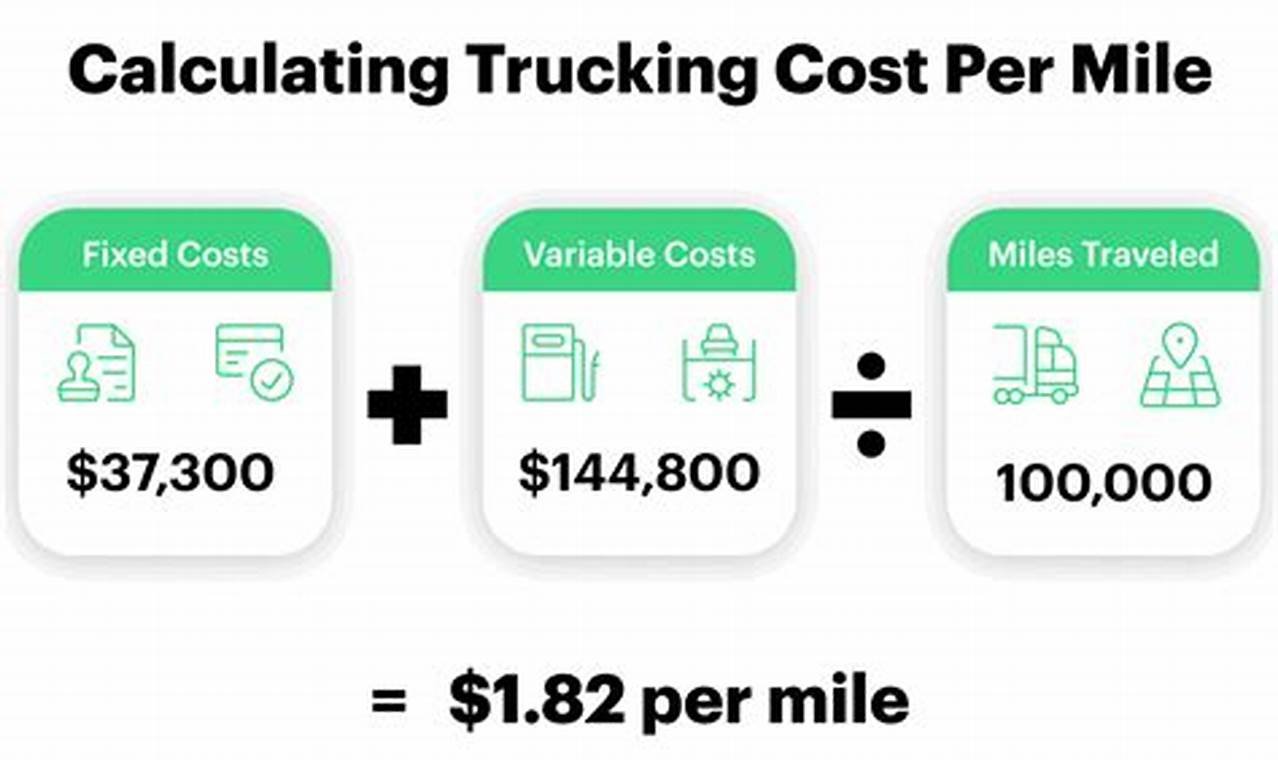
Total Operating Costs ÷ Total Miles Driven = Cost Per Mile Trucking
The key is using total miles, not just loaded miles. If you only calculate against loaded miles, you’ll flatter your own numbers and talk yourself into rates that don’t actually cover your business. Deadhead miles still burn fuel and put wear on your truck — you just don’t get paid for them. Counting only the miles you were paid for is how operators fool themselves into thinking a rate “looks good” when it doesn’t. A basic monthly example:
- Truck payment: $2,200
- Insurance: $1,500
- Permits/subscriptions: $300
- Fuel: $4,200
- Maintenance/tires reserve: $900
- Tolls/parking/misc: $400
- Total costs: $9,500
- Total miles driven (including deadhead): 8,500
$9,500 ÷ 8,500 = $1.12 per mile fixed cost baseline, before you add a profit margin or pay yourself a salary.
That number is your break-even rate — the floor below which every load loses you money. Add the profit margin you actually want to run (many operators target $0.30–$0.50 per mile above break-even), and now you have a real minimum rate you should be comparing against every rate confirmation that comes across your phone. One important note: this isn’t a “set it once and forget it” number. Fuel prices shift, insurance renews at a higher premium, and a slow month spreads your fixed costs across fewer miles, pushing your cost per mile trucking up even if nothing else changed. Recalculate monthly, using a rolling average if your mileage swings a lot from one month to the next.

What a Healthy Cost-Per-Mile Looks Like in 2026
Every truck is different, but current industry data gives you a useful benchmark to compare yourself against. Across the industry, full operating costs (including driver pay) have been running in the neighborhood of $2.20+ per mile, with non-fuel costs alone making up the bulk of that. For an individual owner operator running a financed truck, though, the picture usually looks a bit different once you strip out company-fleet overhead:
- Under $1.30/mile — Lean and efficient. Usually means a paid-off truck or very low fixed costs.
- $1.30–$1.60/mile — Solid. Typical for a financed truck run with discipline and low deadhead.
- $1.60–$1.90/mile — Getting tight. Margins shrink fast if rates soften, and it’s worth auditing insurance, financing, and deadhead percentage.
- Over $1.90/mile — Danger zone. You need consistently strong rates just to make a modest living, and any dip in the freight market puts you in the red.
On the revenue side, 2026 spot rates have generally been trending upward as capacity tightens, with dry van freight commonly landing in the $2.00–$2.50 per mile range, and reefer and flatbed running higher. That gap between your cost per mile trucking and what the market is paying is your actual margin — and it’s shrinking or growing every time fuel prices move, insurance renews, or you take on a bad lane.
Even though the second dispatcher booked fewer loads, the owner operator may finish the week with higher profits because operating expenses remained almost the same while revenue increased. That’s why choosing professional dispatch services is about much more than keeping your truck moving. An experienced dispatcher understands freight markets, seasonal demand, broker relationships, and lane pricing. They negotiate with profitability in mind rather than focusing solely on keeping the wheels turning.
Fuel alone typically makes up 25–40% of total cost per mile, which is why small efficiency gains — slowing down a few miles per hour, staying current on tire pressure, cutting unnecessary idling — compound into real savings over a year. But fuel discipline can only take you so far if your rate per mile isn’t covering your costs in the first place.
How a Dispatcher’s Rate Negotiation Affects Your Margin, Not Just Your Revenue
Here’s where a lot of owner operators leave money on the table without realizing it: they hire a dispatcher to keep them moving and measure success by how many loads get booked, not by what those loads actually pay per mile. A dispatcher who fills your calendar with loads at your break-even rate isn’t helping your business — they’re just keeping your truck busy.
The dispatchers who actually move the needle are the ones negotiating rate per mile as the primary goal, not load count. Experienced negotiators regularly push an extra $0.20–$0.40 per mile out of the same posted loads that a new or passive carrier would accept at face value. On a truck running 8,000–10,000 miles a month, that difference isn’t small — it’s the gap between breaking even and actually building equity in your business.
This is exactly why it’s worth understanding your own truck dispatch service costs alongside your cost per mile trucking. A dispatch fee that looks expensive on paper can be a bargain if it consistently raises your rate per mile more than it costs you. And a “cheap” dispatcher who books volume without negotiating is often the more expensive option once you measure it against your real cost per mile trucking baseline. If you’re evaluating whether to run under your own authority or partner with a dispatch service, our Owner Operator page breaks down what to look for beyond just “who finds the most loads.”
Free Cost-Per-Mile Trucking Worksheet Copy this table and fill in your own numbers monthly. Keep it simple — you’re looking for a working number, not a perfect one.
| Expense Category | Monthly Cost | Fixed or Variable |
| Truck/trailer payment | $ | Fixed |
| Insurance | $ | Fixed |
| Permits & subscriptions | $ | Fixed |
| Fuel | $ | Variable |
| Maintenance & tire reserve | $ | Variable |
| Tolls, scales, parking | $ | Variable |
| Lumper/detention costs | $ | Variable |
| Total Costs | $ | |
| Total Miles (loaded + deadhead) | ||
| Cost Per Mile Trucking (Total ÷ Miles) | $ |
Once you have that number, add your target profit margin (a common range is $0.30–$0.50/mile) to get your minimum acceptable rate. Write that number somewhere you’ll actually see it — a sticky note on the dash, a note in your load board app, wherever keeps it in front of you before you accept a load.
Why Consistent Cost Tracking Matters
Many owner operators underestimate how much cost per mile trucking influences their annual profit. The drivers who consistently review cost per mile trucking every month usually make better decisions than those who only look at gross revenue. When you ignore cost per mile trucking during slow seasons, you may accept loads that barely cover your expenses. On the other hand, understanding cost per mile trucking helps you identify profitable lanes, reduce unnecessary deadhead miles, and plan for future maintenance.
A detailed cost per mile trucking calculation also gives you confidence when negotiating rates with brokers and shippers. When cost per mile trucking rises unexpectedly because of fuel prices, repairs, or insurance increases, you can adjust your pricing strategy before profits disappear. Tracking cost per mile trucking consistently allows owner operators to build a stronger, more predictable business instead of relying on guesswork. Over time, this habit becomes one of the most important financial practices for protecting margins and growing a sustainable trucking operation.

FAQ
What is a good cost per mile for a trucking business?
It depends heavily on whether your truck is financed and how you run, but most financed owner operators land somewhere between $1.30 and $1.80 per mile. Anything consistently above $1.90 per mile leaves very little room for a slow freight market or an unexpected repair.
Does cost per mile trucking include driver pay?
If you’re an owner operator paying yourself, most calculations separate your operating cost per mile from your take-home pay so you can see your true break-even rate before you factor in a salary. If you employ a driver, their pay should be included as a fixed or semi-fixed cost.
How often should I recalculate my cost per mile trucking?
Monthly, at minimum. Fuel prices, insurance renewals, and swings in your total mileage all shift the number, so treating it as a one-time calculation gives you a false sense of security.
Should I include deadhead miles in the calculation?
Yes, always. Deadhead miles cost you fuel and time even though they don’t generate revenue. Leaving them out of your total mileage will make your cost per mile look artificially low.
How much does a dispatcher affect my cost per mile trucking?
A dispatcher doesn’t change your operating costs, but a good one directly improves the rate side of your margin by negotiating higher pay per mile instead of just filling your schedule with volume. That’s the difference between staying busy and actually growing your business. Not sure whether the rates you’re being offered actually clear your number? Work with a dispatcher who negotiates on rate per mile, not just load count — see how it works with our owner-operator dispatch service.